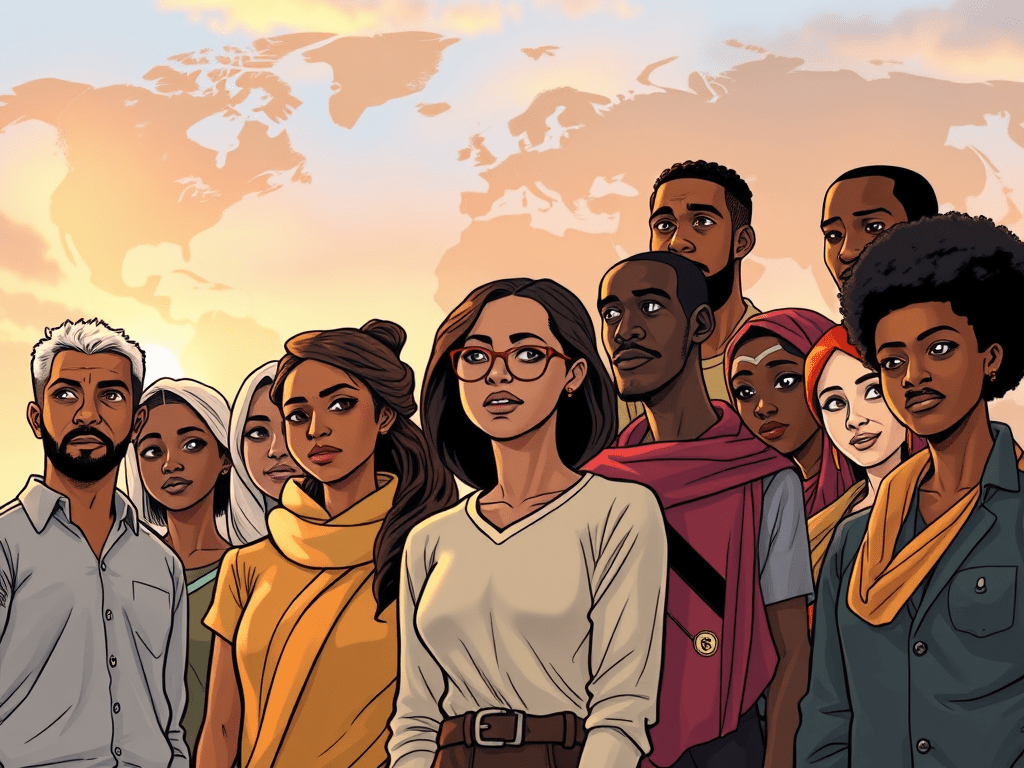
Countries are over-rated. This comes from one who was born in one, with parents of two, and raised in a third, of which they were never a citizen, with a significant family presence in a fourth – one who eventually has to admit they really aren’t from anywhere, and never were. When people say, sometimes with a great deal of pride and confidence, “I’m British”, “I’m Indian”, or “I’m Ukrainian”, a question arises. What is this, “I am…”? For some, this being from somewhere is clearly a straightforward thing. Maybe they were born and raised and hold citizenship all in the same place, which means that is ‘their country’, of which they hold the passport and can claim they are a full member. That is their history and identity. Others have mixed heritage. And for some, it can be a case of mixed heritage, plus migration, complication or just a general lack of clarity.
Countries are over-rated because they are arbitrary. Some go to great lengths explaining how their country differs from other countries; how ‘their’ people differ from those across the border. Countries are tribal. There is that sense of a nation turning towards its own; prioritising the ins over the outs; favouring the in-group like a bunch of children in a school playground. Like children, they make their rules about who can be admitted, who belongs, what they must do to become part of the in-group, and how hard or easy it should be to gain the coveted status of citizen.
I can think of one particularly arbitrary country that insists on a period of proving one’s commitment to a place that one may have called home since the age of two. The rules say that one cannot leave for more than an arbitrary number of days during the period of proving one’s ‘commitment’ to that country, and only the last five years will be taken into account. One must be of good character, and one must provide letters to prove it. Yes, they say, these are our rules and if you want to be a citizen who is welcome in our country, then you must abide by them. Never mind you thought it was your home. Or that you thought you belonged here, or that you lived here all your life: prove yourself, and then we might say you’re welcome here. Or not.
There is a difference between those who choose to migrate, and those who are moved as children. The former makes a choice; the latter are simply passive ‘baggage’ as it were, with no will or choice in the matter. This makes a difference when it comes to later life and identity. Because, this whole question of where one comes from is important on some level; it matters. People ask “Where are you from?” It’s supposed to be an easy question; an icebreaker even. The answer can determine so much. But when there are no easy answers, the matter of country can be a source of pain. Every question is a reminder: nowhere. Yet, it can also be a source of strength.
Colonisation adds another dimension. In a country where the indigenous people were effectively invaded by a foreign empire, this notion of who has rights to be and to belong in a country becomes all the more interesting. If the colonising people weren’t entirely welcome, or their actions were wrongful in certain ways, should later rules be made according to their systems and ways of thinking?
“Not I, some child born in a marvellous year, Will learn the trick of standing upright here.” – Allen Curnow
Curnow’s final couplet captures a sense of colonial uncertainty. If there’s a tendency towards a collective sense of unease in colonial or migrant cultures, there’s certainly an individual unease. What right do I have? Why do I feel entitled to be here, and on what grounds? And the thought that, just maybe, I should go back to where I came from. In some ways it’s easier knowing that the soil beneath one’s feet is where one’s ancestors lived and died – endlessly, for generations of solid belonging somewhere. Before wars got in the way, or economic hardship, or any number of other reasons that drive people across oceans in search of new beginnings.
Growing up in a country where one doesn’t hold citizenship, there can be certain challenges that others are unaware of. The pain of feeling like one should belong, but knowing one doesn’t fully belong on paper. Not having equal rights. Not having the passport of that country, or passing through segregated lanes at the borders. This is the life of a permanent outsider. “No one’s saying you can’t get citizenship” may come the blithe retort when this situation is put into words. Maybe they forget that arbitrary countries have arbitrary rules. They forget the number of days that need to be counted, the number of commitments that must be proved, the filing of paperwork and paying of fees – all this to be part of their country; a country one lived in since they were a toddler.
Some people go to war for their countries. For someone who doesn’t have a country, this sentiment is hard to understand or relate to. Even when trying very hard to feel what it must be like to have this all-consuming love for one place and people on earth; a love defined by clear geographical boundaries, and for which one will fight those of other countries because “this is mine” or “it is ours”, the feeling fails to materialise in any meaningful way. For one who has no country this is a foreign concept. Boundaries are largely irrelevant.
As for maintaining a sense of personal identity, beyond a national identity, it takes a good deal of acceptance and a widening appreciation of what matters. Rather than being of a country, or even being from somewhere, a migrant’s many strands can lead to a widening sense of identity. A narrow sense of belonging to a particular place can, eventually, give way to defining oneself by values rather than a particular place, or way of life. When there is no country, it becomes necessary to adapt. It is necessary, if one is to go on and not give up, to put the whole business of country in perspective. It may even be necessary to let go of the excessive love and care for what one thought was one’s country, and transform that energy into something more global and inclusive. It is possible to realise a love for many peoples, and many places. It is even possible to feel a little patriotic, on behalf of wherever one goes.
Image and Title Credit: AI
 Fuzzy Brown Line