-
Two very different cases of capital punishment
“Will there be a reprieve?” was the first question. No sooner had there been a reprieve, before news of Christa Pike’s failed execution was breaking, in all its sickening detail. There are three aspects of Christa’s case that gave me reason to question what was happening here. By which I mean seriously questioning the death penalty as a punishment in this particular case, beyond any more general questions over the ethics of capital punishment.
First, Christa’s age at the time she committed the crime. She was 18. If she was convicted again today the outcome might be quite different – eighteen is the threshold that defines a ‘juvenile’ under US law. She was, by any understanding, very young. As pointed out in this letter, current neurological understandings of brain development suggest the brain keeps developing till around the age of 25. And, what people do when they are 18-year-olds, versus what they might become, can be two very different things.
Then there were the revelations about the abuse she suffered as a child – this sitting at the extreme end of childhood sexual abuse. The odds of her having a normal life had perhaps been stacked against her from a young age. I was reminded here of some of the incarcerated people I have written to over the years, as part of a prisoner correspondence program. Christa’s case was not dissimilar to some of these cases, in terms of both age at offending and adverse childhood experiences. Not for the first time, I considered that some of the extreme experiences people went through as children, were almost inevitably going to create issues of some sort in later life. Some of those that go on to become serious offenders were victims first.
Third, the matter of accountability and punishment. What struck me here is that Christa having been in jail since the age of 18, on death row, until her present age at 50, would in itself seem to have met the requirement for punishment by a “do the crime, serve the time” measure. Yet, here she was all these decades later, being subjected to death as if the balance was still wholly owing as it had been on Day 1. Now, some will no doubt argue that it is, and always will be, because her victim was deprived of life, and her victim’s family was left without her, and nothing is going to change that or bring her back to them. And it is this last point in particular which is pertinent, I think: making a perpetrator suffer all manner of punishments doesn’t undo the loss of life, or the loss to family, or the heartache more generally. In the case of the death penalty, it repeats what it seeks to condemn, adding further misery and suffering in the process.
I have to say that even reading the news about this case felt like a form of collective misery. The thought of an execution being something that people could volunteer to watch only added to the inhumanity of it – at this point it felt a bit like like being back in the days of public lynchings and witch burnings. Not only that, but subjecting a victim of childhood sexual crime to this level of coercion and humiliation was beyond any comprehension of reasonable justice. Finally, research indicates that the death penalty does not serve any more of a deterrent effect for committing crimes than life imprisonment.
Remarkably, Christa not only survived her attempted execution but appears to have recovered to some extent, which raises the question of what might happen now. To my mind, there is potential for Christa to put her experiences to use in ways that might be socially beneficial and helpful. An obvious question is why people commit these kinds of crimes, and how to lower the likelihood of them happening in the first place. On that count, Christa’s experiences might usefully inform a preventative approach, if they haven’t already done so.
The case of an army psychiatrist
Christa hadn’t even left hospital after the failed attempt on her life, before this case was being publicly aired, or re-aired. Here again was news of the death penalty being invoked, but in a case of a very different nature. This was followed by the decision to livestream the execution of Hasan by firing squad. It is a case which sits at the intersection of a military, psychiatric and religious — specifically a radicalised religious – context. That these three institutions might, under certain circumstances, intersect and create the psychological backdrop for the kind of offending committed here I do not find entirely surprising. I will take a look at the first two below, and consider how they might be illogical and dubious at the best of times.
First, the military context. Here there is the not-so-trivial matter of state and socially sanctioned tribal violence, where violence is normally not something that is allowed or condoned. This hinges on the notion of ‘the enemy’; that group of ‘others’ at which one is going to take aim, sometimes for no other reason than that the state has deemed it justified to do so. There must be willingness to get involved in violence – even in countries that are at peace – in a way that would normally meet the threshold for some sort of disorder. That there might be latent mental issues within the military should perhaps come as no surprise, then. It also raises the question of how one might reasonably detect or handle other forms of extremism or radicalisation within such a context. Glorifying guns and weapons? Not tolerated in civilian life, yet paraded about publicly and given the semblance of being inherently ‘honourable’ as part of military events. As I said before, a dubious institution at the best of times.
Then we have psychiatry, renowned for pathologizing distress so that it becomes a disorder of the individual, rather than any sickness on the part of a society or its institutions. An army psychiatrist would likely see very many cases of what the profession calls “Post Traumatic Stress Disorder”, or what in this context might otherwise be described as “the adverse mental consequences of being involved in the operations of the dubious and illogical institution known as the military”. The military, in counselling such individuals, would likely have in mind the need to return its members to whatever conflict they have at hand, or perhaps have in mind – something Google AI pointed out to me, and which it refers to as “maintaining force readiness”. What kind of a therapeutic climate this creates is hard to tell, but I doubt it would be much conducive to the popular notions of wellbeing or flourishing. It brings to mind words like “compartmentalising” (again, thanks to AI).
As institutions, both the military and psychiatry hold inherent ethical problems and contradictions. The violence perpetrated by Hasan is an extreme case, tragic in its consequences, but it is not an isolated one. This page outlines the cases of former military service members on death row, raising the question of how their experiences may have contributed to their offending. Again, there is the question of what happens next. Again, I do not believe the death penalty will really help anyone or anything move forward or onwards. Live-streaming an execution is sick. Where that footage might end up, in whose hands it might fall – or play into—and the potential consequences of publicising extreme violence in that way are also worth considering.
As a final thought, I think it would be interesting to ask the individuals at the centre of these two very different cases what they see as the best means to atone for their actions, supposing that is something they are interested in.
-
On attending an Ethics Symposium on the 2nd October
Occasionally, I still try to go to a symposium, or some kind of academic conference. It is always interesting to see the general picture of who is there, who isn’t; how much academia has changed, or how much it hasn’t — and that is quite aside from what might be said on a topic like Ethics.
At the beginning, in the talk about Applied Ethics, there was mention of Biomedical Ethics, research ethics, informed consent. There were three waves, the speaker said, in which applied ethics had taken shape: these waves coincided roughly with three twenty-year intervals ranging from the 1970s till today. During the first wave, dominated by biomedical ethics and research ethics, there had been these ‘life and death’ questions around issues such as euthanasia and abortion. Questions of informed consent had arisen out of the human genome project. Dates that would come up more than once were the Nuremberg Code of 1947, and the Declaration of Helsinki (1964).
There were many empty seats at this symposium, I noticed. I wondered about the people who might like to have attended, but who were quite possibly too busy paying for their lives and living costs. Local students had been out protesting just the other day about the fact that many were being forced to choose between working to live, or studying. Others were completely burnt-out from trying to juggle both. And only yesterday, I had been out in a rural field where people were being paid just over 7 euros an hour to remove rocks from the ground. It was fairly taxing, physical labour. To put that number in context, the minimum wage in this particular European country stands at €5.67 per hour. By that measure it was generous, if still well below what might be expected to maintain oneself and still have time for an Ethics Symposium or two on the side, without being too worn out to even think about it.
Anyway, back to the matter at hand. At some point there was mention of “echo chambers” in relation to social media — this being the idea that people on the internet tend to talk to those who already agree with them, and who reinforce their existing opinions. Later, another presenter would finish their talk by saying that academics really needed to start “communicating beyond the usual suspects”. Smart use of social media might be needed. Wow!
Academics have been saying these sorts of things for as long as I have been listening to them. It’s almost like a friendly confession amongst friends: A kind of “Yes guys, we really need to start communicating amongst more than just ourselves, haha. It’s very nice in here with the jug of iced water, the flowers and the presentation slides, but hey, we really do need to start making an effort to get out there. Eh, guys?”
Back to the conference: “Bridging the gap”. Gaps without bridges seem to be another one of these intractable problems that academia has spent at least the last twenty years fruitlessly grappling with. It has got to the point where it has the ring of a kind of therapeutic soul-searching; the kind one can always return to and still find it wanting. First, there is the gap between academia and practice, or the real world. This I can remember hearing about in lectures about human-induced global warming twenty years ago. Then, it was the idea that with all this scientific knowledge, there was this huge gap between the science and the general public. It needed to be bridged, somehow.
Today, there was talk of gaps within the university. Specifically, how much was ethics a matter of the individual and their behaviour, and how much of it lay in the realm of a responsible institution? Now, there were these young researchers coming through, who faced immense career insecurity. Really, the role of an institution was to be an enabler so that upholding ethics was a matter of ease for the individual; something that came naturally. (Again, I thought of the student protest, and the pay rate for picking up rocks). If one is going to start bridging gaps, would it pay to start addressing the most egregious gaps first, rather than beginning with the cases of what I would call first world problems?
Creating “actionable policy” was still a work in progress, the speaker said. It was all very well having these brilliant ideas in the thin air of academia, but, sadly, there was still this imperfect world out there (this last bit being my thoughts on what was said). “CUDOS”, she said: “Communalism, Universalism, Disinterestedness, Organised Skepticism” (these last two being joined together). The empty seats were almost flashing like warning lights. I wanted to speak, but knew that it probably wasn’t a good idea. I was feeling too distressed by now. I heard the words “individual distress”, “agency”, “enabling feedback loops”, “fair career incentives” and “need to walk the talk” in no particular order.
I needed to get out of here. I needed to walk. The answer was not to wait for the time when the microphone might travel beyond the usual suspects so that I might try and put all this into words, however awkwardly – no. I had to get out. And that is what I did. It was with a sense of relief, and agency, that I got out into the 2nd October sunshine.
-
International Day of Peace
International Day of Peace was first established in 1981. This year, the United Nations has adopted “Invest in Peace” as their motto for the day. I believe there is an associated hashtag for those who wish to use it. Even if I were still in the habit of hash-tagging, which I am not, I would not feel inclined to use this particular line. To me, ‘Invest in Peace’ sounds a bit as if Peace is a stock on the share market. I won’t dwell on what ‘Peace’ might be doing right now if that were the case. What I do find interesting about this call to action, is that it makes us think about what investing in peace might actually entail – beyond any connotations with the world of corporate investment.
There has been much talk in recent months about ‘investing in defence’. Less euphemistically this might be termed ‘investing in war’. Investing or taking actions towards peace seems to get less coverage. It is almost as if the idea of peace is reserved for that one special day a year, when people are encouraged to actively promote and invest in it. On the other 364 days, when the usual working mood takes hold, peace takes a back seat to investing in defence. There are various reasons why this might be. An obvious one is the threat, or presence, of armed aggression. While that is real and present, it does not make looking at pathways to peace any less important. I would argue it makes the need to think about peace – specifically non-violent means to it — all the more pressing and urgent. It may also have something to do with a lack of clarity as to what active work towards peace might look like. Investing in war is comparatively clearcut – it requires some kind of shopping list, and allocation of funds. Peace, on the other hand, is harder to pin down.
The document I linked to above, the 36th session of the United Nations General Assembly, has this to say:
“…since wars begin in the minds of men, it is in the minds of men that the defences of peace must be constructed, that a peace based exclusively upon the political and economic arrangements of Governments would not be a peace that could secure the unanimous, lasting and sincere support of the people of the world, and that the peace must therefore be founded, if it is not to fail, upon the intellectual and moral solidarity of mankind.”
This text, like many of these high-level resolutions, takes something of a lofty, ambitious tone. Still, I think the idea is a useful one. The analogy of building mental ‘defences of peace’ suggests that as in war, these need to be multi-layered. It is not enough to rely on some kind of political and economic arrangement – peace needs to be something that is felt and embodied in all of us. This sentiment is echoed here, in a 2014 tribute to International Day of Peace by Greg Simons: “Peace needs to not only be firmly established as being a desirable value and state of being, it must also be something that has an active tangible relationship and emotional bond with mankind” (p. 8). Simons adds a dimension of peace being ‘active’ and ‘tangible’, while re-affirming the sense of something felt; something emotional. Finally, there is the 1981 wording from the United Nations again, that if it is to be a lasting peace, it must be founded upon the ‘intellectual and moral solidarity of mankind’.
How to get there, then? The same document goes on to mention the promotion of peace, “mainly through education in all its aspects”. This leaves a lot to the imagination. One thing that I think is important when it comes to education, is being able to understand each other: our different perspectives, histories and life stories. Here, I think language-learning is particularly important, being at the root of human communication. I consider myself lucky to have been able to study languages and take language classes in various parts of the world, and although I have never really stuck to any particular language or become proficient in any of them beyond the basics, the experience itself has been worth a lot. There is something special about any language class – the way it brings people together, opening a window on one culture through one particular language, while potentially mixing a diverse range of backgrounds and cultures together. This kind of education is, to my mind, at the heart of education for peace.
Something language classes also offer is the potential for random mingling and talking — something that is becoming increasingly hard to find. In education, as in other realms of life, a great deal of our communication is aimed at understanding complex concepts and ideas, or in making sense of abstract problems. While that may be interesting, stimulating, challenging, necessary even – it is possible to get so caught up in this, that the very humans underneath become a distant secondary; a means to an end rather than the end itself. This is something of a shame, I think. Some might say we have the internet for those conversations, where once we had the town square. But the internet and words typed into screens are not the same as real people and real conversations. At least I don’t think so.
As I type these words on my screen on the evening of International Day of Peace 2026, I am aware it is getting rather late in the day. And on that note, I wish anyone reading this a peaceful evening.
-
Ukraine – the rolling death toll
37 dead here. Five dead there. A whole family obliterated. A two-year-old killed.
Sometimes I feel like shouting; screaming even: “Wait, stop the clock! Five people died today!”
Five lives – of which each had only one. Five whole lives, with all the connections of life, and all that an individual life means and brings. Gone.
But I don’t scream or shout. Instead, I think about other things like natural peace and quiet, about an interesting book, or a concert maybe, or what I’m doing for the rest of the day.
Even when I was in Ukraine, life went on. A city can’t stop because X number of people died that day – killed not by natural disasters, or the kinds of unfortunate but largely unavoidable things that happen in life – but through the wilful actions and destruction of war.
Cities go on. People go on. The city flags hoisted in memory one day, then lowered, and life carried on – the other volunteers and I; all the people of the city who had not happened to die that morning or the previous night; all the people who still had their lives to live.
When I think about it like this, it is completely crazy. On some level I feel selfish, unbearably so. It is all very well being grateful, but carrying on like this feels like wilfully choosing to live in a parallel universe.
Of course, it is possible to do all sorts of little things around the edges: donate some money, volunteer at this or that – but these are the kinds of things that are mostly just a salve for the soul – something to feel good about; that give a sense of having done something, of helping in some small way – a way of alleviating the pressure, in other words. But they don’t get anywhere close to touching the root causes.
That said, what else can we do? We can go on social media and send messages into the ether. What that achieves is hard to gauge. Connections between people, social movements, collective action – these may have been stronger in real terms before the advent of social media.
What to do?
-
Borders and Edges
Sometime during the Summer, I found myself walking along the edge of a military training ground. This was not quite as random or unexpected as it might sound. Back at home, while planning a south to north route through this stretch of country, I noticed the way the mapping app threw up a series of ominous red cross hatching. It seemed to suggest something along the lines of “Here be Dragons”. When I investigated further, I found it was listed as an active military training zone. And looking still further, I found a bristling calendar of scheduled activities, along with their anticipated noise levels. As I had no wish to be circumnavigating even minor pops or sporadic bangs, there was more work to do.
Looking at these red cross hatches on the map, and at the training schedule, I wondered if I was perhaps seeing activities for a much greater area than the one I wished to cross. I decided to call the number at the bottom of the page to find out and be sure. The person at the other end assured me that on the dates I was looking to go, there would be nothing happening there, and I could safely proceed to walk my route as planned. This I did. It was, in fact, beautifully peaceful. The area was effectively equipped with multiple layers of warning systems – flag poles, lights, boundary markers. I mused that the demarcation zone I skirted around could be described as being like a second line of defence – except the thing to be kept out of here at all costs was not the enemy, but unsuspecting civilians. Somewhere, much further inside, was the core area where the military did whatever the military does in such places. Walking beside the black and yellow markers gave me reason to reflect on what they might do in there. It was a very swampy area, with great stretches of water and clumps of what looked like fragile plants and semi-aquatic species well adapted to living in bogs. I had the luxury of a boardwalk under my feet. Had it not been there, I could imagine the way the mud would suck at one’s boots. It would not be quick travel. I visualised tanks getting bogged down, and I heard Winston Churchill’s sonorous voice proclaiming “We shall fight in the bogs”!
I may have laughed at the thought, but it really was no laughing matter. Thinking about tanks, and the conventional military training that would have taught people the knack of travel and combat in different environments, or how to use a bog like this to one’s advantage, it occurred to me that this kind of knowledge was becoming less critical, if not virtually obsolete. That is to say, it was now probably more a question of how long someone could sit in a bunker without losing focus on their screen. Drone warfare. It was possible that physical fitness would cease to be as important as it once was, too. I stopped to read a sign which suggested that the conservation values of this area had in large part been preserved because of the restrictions placed on it as a military training ground. For many years, people did not go here. This seemed like a rare case of military activity having had positive implications for nature conservation.
At other times, I traversed land and water borders. I was again reminded of the pre-eminence of drones by a sign asking people to please report any suspicious looking drones to the relevant authorities. The sign did not use the words ‘suspicious looking’ – but I assumed that’s would they would have to be in order for me to report them. I did encounter drones on a few occasions, in other places. Although I found them irritating, I did not report them to anyone. One was being flown over a bog area similar to the one I have just described, but it was a touristic area and I assumed it was being used to look at the view, because the owner couldn’t be bothered walking any further than they had. Another was being piloted by a young boy at a campsite. This was perhaps the defining image of a modern childhood – a young boy with a hoodie drawn over their head, flying a drone over a lake which they could go and experience all the delights of on foot, at ground level, for real. But, in an age of drone warfare, it was perhaps inevitable that every young boy – and no doubt some girls – would wish to be a drone pilot. Thankfully the boy’s parents seemed to get fed up with the whirring and buzzing overhead at about the same time as it was really starting to grate on me. Drone time was over, for now. Peace and privacy were restored; and the natural sound of the wind in the trees prevailed once more.
The border areas occasionally filled me with an ill-defined trepidation. There were hints around the edges – signs of surveillance – that gave a distinct impression of tension. I kept walking. It was, after all, just another part of a route stretching from north to south, or from A to B; something to be crossed or traversed as one might do on any other route. Yet there was this sense of heightened alertness. Some of the things I thought about now, were the kinds of things the very prospect of which would have made me fearful for the future once. It was not even that long ago when ideas that would have sat firmly in the realm of paranoid delusion, were now either reality or much closer to it. Still, I did not like to think where some of it might go.
-
A long walk on flat ground
I have been walking in what Google AI might term “life-affirming terrain”. The AI and I had been in conversation about my recurrent lower back pain at night, and what the key to alleviating this might be. Amongst a raft of rapid-fire advice, from exercises I might like to try, to when to urgently seek medical help, there was this comment about “life-affirming terrain.” It made me laugh. It was interesting, though, because I had confessed to the AI that I liked to frequent the mountains with heavy loads on my back, and it seemed that the implication here was that the mountains were not “life-affirming”, and I should think seriously about going elsewhere – at least temporarily. It just so happened that I was due to leave the mountainous country anyhow, so it was perhaps inevitable that I would find myself in just such “life-affirming terrain” at some point down the track.
I will take a moment to add that an AI version of Dr. Google was never something I specifically requested. Nevertheless, the word “thinking” along with a pulsating dialogue box, followed by a long and detailed response, have become something I have quickly got used to. As far as I know there isn’t an off-switch for this supposed advancement – one has to use other means of going back, if going back is what is desired. I think it’s amazing how some of these new developments get rolled out with hardly a whisper of discussion, and not so much as a question as to whether it is something we think we really need or want. I can remember when something as relatively minor as a change of formatting was something you could try out early on, or else delay adopting until later. Even that wasn’t exactly a true choice, but it was more of a choice than some of the recent developments have been. When it comes to things like the energy involved in running AI data centres, it is perhaps interesting that it isn’t a case of opting-in.
Anyway, I digress. The AI doctor had mentioned the amount of extra strain that was required in walking uphill, particularly with a heavy load on one’s back. I have to admit there are other ways, apart from the extra strain involved in going uphill, in which the mountains might be less than life-affirming, or even life jeopardising at times. On my last trip in the mountains, after the trip to the alpine basin I wrote about in my last blog post, I revisited another route I had travelled part of on a previous occasion. On that previous trip, I had made the classic mistake of following an easy feature of the terrain – a nice bench running below the main ridge – as far as it would go. At the end of it I was faced with a short but steep climb up a gully, the top of which sported something approaching cornices. I managed to find a reasonable route up to the top that steered clear of these, but it was not a line I would choose as a snow route a second time. This time I did not follow the bench to its bitter end, and instead chose to angle upwards much earlier.
This was easy enough to do. Looking at the slope angle, and the consistency of the snow, and the run out below, I considered the possibility – and consequences – of an avalanche. There were many memorials to avalanche victims around these mountains. Somewhere in the depths of my memory bank, I recalled that walking across a slope as I was about to do here, was effectively like perforating a line in the snow where the whole lot might have more reason to let go. Now, I was not sure how much that applied here, and I was also aware that I was pushing the limits of my knowledge and understanding of avalanche risk. There was also a thought that the mountains sometimes presented these situations where the risk of continuing might feel somewhat unacceptable, yet turning around and going back would present its own set of risks. So I continued, with a methodical but steady progress across the slope, and then up onto the ridge. Getting away with something wasn’t confirmation it was OK – that was another classic mistake, but I had made it. There was a sense of satisfaction in having chosen a better route this time in light of what I’d learned last time.
On my recent venture in life-affirming terrain, I had ample time to reflect on the nature of different outdoor experiences. Sometimes there is a sense of nostalgia for something, without even realising we have a sense of nostalgia about it. That was the feeling I had when I pushed open the door of the first long-drop toilet I encountered on this journey. It was a wooden structure, with a bit of long grass around the door, and that slightly musty smell that I had all but forgotten. Suddenly I realised that this whole experience – of camping in a tent, maybe by a bit of water that was swimmable but not particularly spectacular in any sense, with a long drop toilet and a place to make a fire – this was the essence of the camping holiday we would have once a year when I was a child. We would drive around until we found somewhere by a river, or even a little creek. Many of the campsites were just like this. There would be the long-drop toilet with the resident spider, the pleasant grassy places to pitch a tent, the fire grate, and maybe some other families with their tents. That was before huge numbers of people started to put pressure on everything, and before moves to modernise and update the camping experience had taken hold. At some point the wooden toilets had been replaced by plastic ones. ‘No camping’ signs had started to appear. Gravel surfaces started to replace grassy ones – vehicles had become larger, and people wanted to drive further and closer than before. The paid campsite, complete with enforcement officers to check all campers had paid their fees, became common place. Something had changed.
Now, this one long-drop toilet had suddenly made me realise something which I didn’t even realise had been lost – the joy of a basic camping existence, and that in life-affirming terrain. I would come across grassy spots with beautiful outlooks across lakes, where I assumed there must be a ‘no-camping’ sign just up ahead somewhere. Instead, there were signs saying you are welcome to camp here, help yourself to some logs from the shed for a fire, please keep the place clean and use only what you need. And you are welcome to boat on the lake, as long as the boat doesn’t have a motor. These rules made a lot of sense, I thought. Boats with paddles and sails were aligned with nature, and the peace of the surroundings. Boats with motors were loud, fast and potentially dangerous to others on the water, yet they had been unquestioningly normalised in many places as if it was somehow a ‘right’ for some to go somewhere and disturb the peace and enjoyment of others.
Towards the end of my walk, I started to slow down. This is something I find often tends to happen on long walks. Concerns about how well supplies might last the distance start to diminish, and a certain sense of just cruising along sets in. I had been using my phone as sparingly as possible, in order to conserve the battery. It occurred to me that I had navigated without a phone once. Now, I had become accustomed to frequently checking my location on the map, just because it was nice to know exactly where I was at any time. Technology had made it possible to do so. As I got closer to civilisation, I started to pay more attention to some of the notifications popping up: news headlines and messages with details of events and incidents happening in other parts of the world. Not for the first time, I considered the ethics and value of walking around like this, the way I had been doing. I looked at images of destroyed buildings – things that people had cared about, which had been purposely destroyed. There was a short clip, in which a fireman tossed aside a sheet of iron, in a move which must be repeated every day in the course of putting out fires.
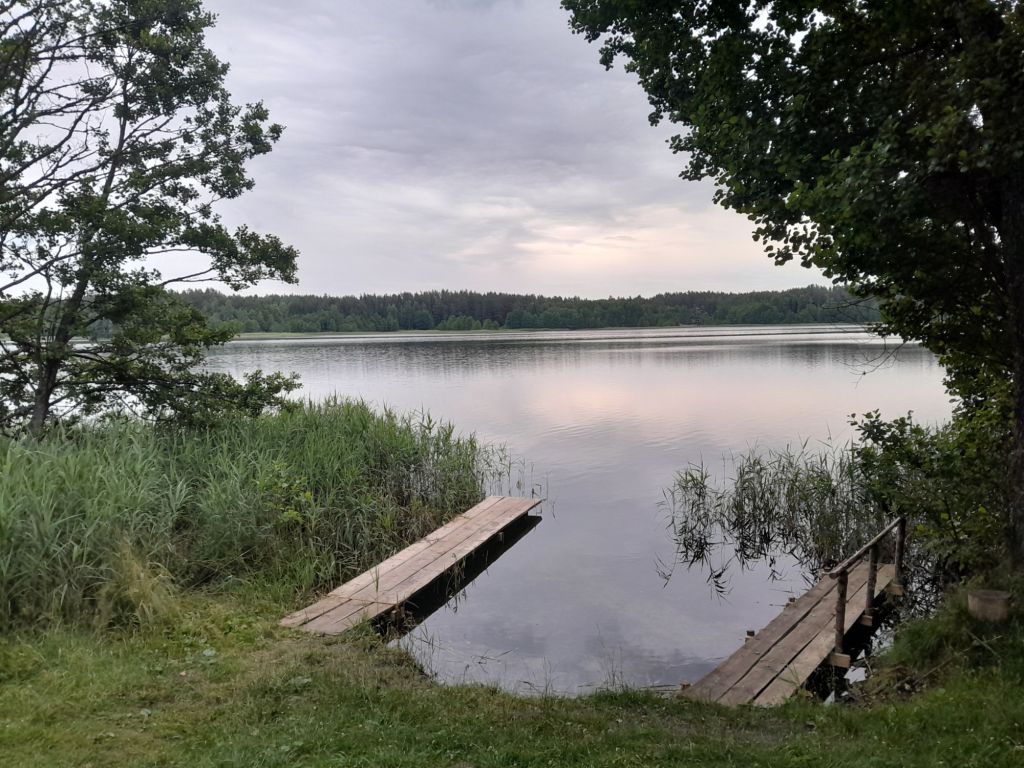
I had reached the final lake in what had been a series of legs from one river or lake to the next. All that really mattered was making a bit of progress each day – some days were longer; others shorter. I got up with the sun – well, a bit later actually, as daylight arrived incredibly early around here – and went to bed when it finally got dark. Along the way I had picked berries, gone for a swim most days, and lived constantly in whatever the weather was doing that day. It was a very simple existence. My back felt OK. Life was good. It had been a long walk on flat ground.
-
Born to a world in crisis: A critical look at having children in the 21st Century
Some months ago now, I found myself in the company of a man and woman about my own age, perhaps a bit younger. They were not from here, and the woman had many questions about the country. Amongst other questions, she wanted to know things like: was the tap water safe to drink, and what about the fruit and vegetables – were they OK? I said I’d drunk the water for a year without issue – that was not to say there might not be dodgy water somewhere, but I hadn’t had any problems. And as for the fruit and vegetables, they appeared to me to be of good quality, although admittedly I hadn’t investigated their origins or methods of production. I added that I generally washed everything first before eating, but that I would do the same anywhere. She seemed satisfied with this. The reason she was asking, she said, was because she was expecting a baby. She wanted to be sure that what she was eating and drinking was safe, and not liable to compromise her unborn child in any way.
Now, on some level this made perfectly good sense to me, and I think I made some remark to that effect. I congratulated them on the baby. I also thought of the news that week, the general state of the world, and the cascading mix of environmental crises. There was little point commenting on any of this negativity when something like having a baby was done and dusted, or due to be. One might as well be celebratory. Yet with every infant-to-be that I am informed about, I have this feeling of unease. The reactions that I express might well be the result of social conditioning, rather than an honest appraisal. On hearing the words “We’re having a baby”, part of me is instantly filled with gloom at the thought. I feel inclined to say something like: “A baby!?! How could you??! In this world??” But that would be inappropriate and therefore I do not say it, although on some level I feel it.
The young woman who asked me about the water and the vegetables was clearly a thoughtful kind of person. Perhaps she had considered the state of the world, and decided that — on the balance of probability – it was still a good enough place with good enough prospects and a reasonable future for a child. To me, the scenario was a bit like being seated in a passenger jet on an unpreventable collision course into the ocean, and calmly asking the passenger next to you whether they think the tray table is clean enough to eat off. I don’t know what the logic is when people make these decisions, and somehow it never seems a good time to ask. I am almost inclined to think that perhaps there is no logic – that the having of children is still a blind, evolutionary programmed, instinctual thing to do, that sits in a realm of its own somewhere beyond reason or questioning. I suppose it is worth noting that some children are purely accidental occurrences, although in today’s world, there is less real ‘accident’ about it than what there might have been once. My own ancestors excelled at procreation. They had families of a size that would have challenged anyone’s means of provision, and which would have been particularly draining on a meagre existence. Amongst the Scottish ancestors, there is a record of a child having been nick-named ‘Midge’ after an annoying biting insect found in the Highland regions in which they lived. Scottish humour aside, I suspect this says something of the mood at child number nine or ten coming along. Those were the days before contraception, of course.
I remember reading somewhere – and as usual I can’t remember where – that nowadays bringing a child into the world is one of the biggest non-consensual acts ever undertaken. On top of that, it seems to receive very little in the way of critical attention – or at least much less attention than one might expect for something of that magnitude. Much of what I have seen on the subject relates to the wishes of parents, and whether or not the presence of a child or children will enhance their wellbeing and general life satisfaction. Little is said about the prospects of the child, even supposing it is born into the most solid and nurturing of families.
During recent wanderings, I have stood atop a number of viewing towers looking down at the forest spread out in all directions. “Well”, I think then, “there is a lot of forest around here, and all I can see is forest in all directions. It is still a beautiful world, and things can’t be so bad as all that.” These are the moments when, supposing I were in a position to act on the inclination, I might be most likely to consider undertaking that most non-consensual act of having a child – not at the top of a viewing tower, I might add, but in a general sense. Yet, when I think further, I know that I am being very selective in where I stand, and that I am conveniently forgetting a whole lot of uncomfortable truths that are not to be seen right here and now, and that ecologically speaking this reasoning is altogether less than sound.
At such moments I do not think, for example, of the time we visited a landfill as part of a university ecology course. I am not sure if a word like ‘impressive’ should be used to describe something like the scale of a landfill. Maybe ‘disastrous’ or ‘sobering’ are closer to an accurate reflection. I think that visiting a landfill is one of those things that everyone should do once – a kind of perverse ‘bucket list’ if you will. One doesn’t have to go as far as a landfill, or even consider all the details of climate science, to see the scale of human impacts on the Earth. Walking a stretch of coastline recently, I zealously started picking up whatever rubbish I could. I was limited in that I already had a full load on my back, so there was only so much I could carry. The ship’s waste was out for a start – at least I suspected that’s where a lot of it had come from. Old bottles of WD-40, hard hats, buoyancy aids, water bottles. In what was really a very clean country, it was like seeing a complete overview of all the mess that humanity had created for itself. There were deflated balloons marked ‘Happy Birthday’ and ‘Celebration’ that would have been pretty once; children’s swim rings. I found an unopened pack of 100-odd surgical masks. And of course, the endless bits of plastic – wrappers and labels and fragments off goodness knows what. As the waves bowled in against the shore, I considered that what I was seeing washed up here was only a fraction of what was out there being sloshed around in the oceans. Humans had created a wasteland.
And the thing about rubbish is that every new infant will go on to create more of it — right from their infant days, through a lifetime of using all the things that we have become accustomed to using, potentially right through to their old age. An elderly friend of mind used to comment glumly on “all this medical waste” and he wasn’t wrong. Every part of life, down to the saving and caring about it, uses resources and produces waste, and a lot of it will inevitably end up being thrown away. Good recycling can go some way to mitigating the effects, but it can only do so much.
All this aside, we hear the dire predictions about declining fertility and birth rates, and how this too will create a different catastrophe of sorts – a social one. Because for all the detrimental impacts on the world that humans have, the circle of production and consumption inevitably requires more human bodies to keep the wheels spinning. Governments seek to encourage their citizenry to go forth and procreate, because there needs to be someone to pay the old age pensions and keep the system functioning the way it always has. I am not sure if that is the logic people follow when they decide to have children – I am doubtful. Maybe it has something to do with having company in old age, or a sense of purpose, or someone to carry on the family line. Whatever it might be, it seems to sway heavily in favour of the feelings of the parents as procreators, rather than the non-consensually created children.
-
Gratitude in an alpine basin

I had thought I would head to a small alpine shelter high on the ridge. I had been up there once before, in Summer, and was keen to revisit. This time around there would be snow on the ground – there was still plenty of it. It had that look about it of late Spring snow – the way it tends to get a bit grubby, and less than pristine, but with the more consolidated look of something that has been around a while, and weathered a few storms. It was only a few weeks ago on a trip in these same mountains, when there had been fresh powder snow everywhere. Not so now. I judged the avalanche risk to be lower than what it was then too. Many of the ubiquitous conifers – stunted and smaller at this altitude – were still under the snow. I had found myself plunging into waist-deep holes around their snow-covered branches in places.
I’d settled on climbing up a rather obscure gully which should lead up to my objective in what I judged would be a fairly straightforward manner. I climbed to around 2000m, with all of my alpine gear – a second pair of rigid boots for the snow, ice axe, mini crampons, cooker and fuel, tent and sleeping bag and all the usual stuff. I set up camp beside a large boulder at that point. Now there was a problem, and that problem was a lack of water. I had not found any lower down, and there was none around here, and I knew from my last visit that there was none at the hut. One could get lucky with a Spring snow pack, and find a little seepage somewhere. I scouted around, but there was no sign of such seepages. The words of a high school outdoor-ed instructor came to mind: “If you think you’re going to get by melting snow for water, think twice.” Yes, think twice. Icicles were best, followed by slushy snow. Powder was the worst. That was not much better than trying to melt air into something drinkable. There were no icicles to be seen, so I scraped the slushiest snow I could find into my pot, and poured a little of the water I had carried over top to get it started in the right direction. Then I put it aside to start doing its thing.
The sun reached the basin early next morning. It was a glorious, welcome sunshine after the cold wind and cloud of the night before. The sun shone brightly on the snow and rock faces. I pulled back the tent fly, feeling a great lack of resolve to continue climbing up the series of steep basins towards the ridge. Nevertheless, after a leisurely breakfast of coffee and porridge, I headed off in that direction anyway. No harm in having a look. Already, the snow was soft. I plugged steadily up to the head of the basin I’d camped in, and sat down at the edge of a grimy patch of snow with fine gravel and larger rocks deposited on the surface. I tried to recall what geomorphological process could be responsible for this phenomenon, but struggled to come to a definite conclusion. Some rocks clattered off the higher peaks, as if suggesting an answer, with that distinctive and slightly unnerving sound that falling rocks make in alpine places. I knew I was well clear of them here. The sound reminded me of high camps many years ago, when I heard that sound in the night.
From here the terrain steepened up. I looked at the map. There was about 400m of height gain left to get to the top of the ridge. Peanuts, really. And yet I felt a great lack of motivation about going anywhere today. In some ways the conditions were ideal for it. In other ways, less so. And there was still the water issue. I looked at the partially snow-covered conifers higher up, and considered how much plunging into snow holes there would be. It occurred to me that back in my late teens and early twenties, I would have romped up those slopes without a second thought. If I’d ended up dehydrated or exhausted or sunburnt or all three, it wouldn’t have mattered. If it took all day to get there, it wouldn’t have mattered. I would have revelled in climbing out of the holes even as I fell into them. Now, I sat on my pack in the basin carefully applying my sunscreen and thinking about the effort involved in climbing up through what would be waist deep snow in places, with the need to ration water. Maybe this was the difference in being younger, or older. How set was I on getting to my objective? Not very. It was lovely in the basin. There is a unique sense of calm and peacefulness that comes from sitting in an alpine basin on a sunny morning. It was with a feeling of blissful gratitude that I dug my heels into the slope and lay back on my pack.
Some chamois caught my attention on the bluffs to my right. They skidded around in the snow the way teenage boys might, and pranced around playfully on the rock faces. Occasionally they looked with ambivalent curiosity in my direction. Their behaviour was nothing like the harried, haunted creatures I was familiar with from the Southern Alps. No one shot at them here. The place was theirs, or ours – seeing as I was sharing it with them this morning. I considered the fact that there were no drones in the basin. During the Summer months I had encountered tourists flying drones in some of the more popular spots. This got me thinking about the drones I had encountered more recently in Winter, in Ukraine, that were of an altogether different kind: attack drones. It all seemed so far away sitting in an alpine basin like this, yet it was still happening. Was it frivolous to just sit here in this snowy basin, doing nothing much, and that on a Monday morning? I suspected it was. It was not constructive in any way that I could think of.
Bulgaria had won Eurovision. Now there was another thing that could be deemed frivolous – Eurovision. How Israel had been allowed to participate was beyond me. Even setting aside the matter of Israel’s participation, the thing itself was close to what might be called the pinnacle of frivolity, and the heights of frivolousness. I might well be frivolously sitting here in an alpine basin having these judgmental thoughts, but that was largely a private matter of whether I was using my time constructively, and what might or might not be a more constructive use of my time. Eurovision, with its public reach, was very much a coordinated spectacle; a public exercise in frivolousness. Maybe if the performances were dedicated to highlighting a social issue, or bringing injustice to attention, then that might be different again. I considered that I was definitely showing my age now, and I was being critical, and I knew it. And my thoughts were not in the moment – they were miles away. Still, when there was so much going on in the world – both close by and further afield, was just having a bit of fun still an acceptable thing to do? Did the particular flavour of that fun matter?
I was grateful to have been able to walk up here. I had taken walking for granted once, a bit like I’d taken breathing for granted. But since the accident that shattered one of my vertebrae into tiny pieces, I have not taken walking for granted in quite the same way ever again. I am more grateful for it now. When I took the first tentative steps beyond my hospital bed after ten days of being horizontal, it had felt like a minor miracle – and something that had to be carefully relearnt. The ground seemed very far away. I couldn’t remember having had those thoughts as a toddler learning to walk, and it’s quite likely I didn’t have them then. The ground wouldn’t have been as far away from the centre of my thinking either.
It would have been hard to convince anyone else of the merits of my wandering. I had climbed hundreds of metres up a random gully in order to camp in conditions that were somewhat less than comfortable, only to give up on the objective altogether and sit in the sun in a snowy basin for a few hours instead. Maybe that was part of the reason why I liked these solo journeys so much – there was no one who had to be convinced. It was frivolous, yes, but as always, I wandered back down to the lowlands with a renewed sense of gratitude.
-
Fieldwork in The Netherlands
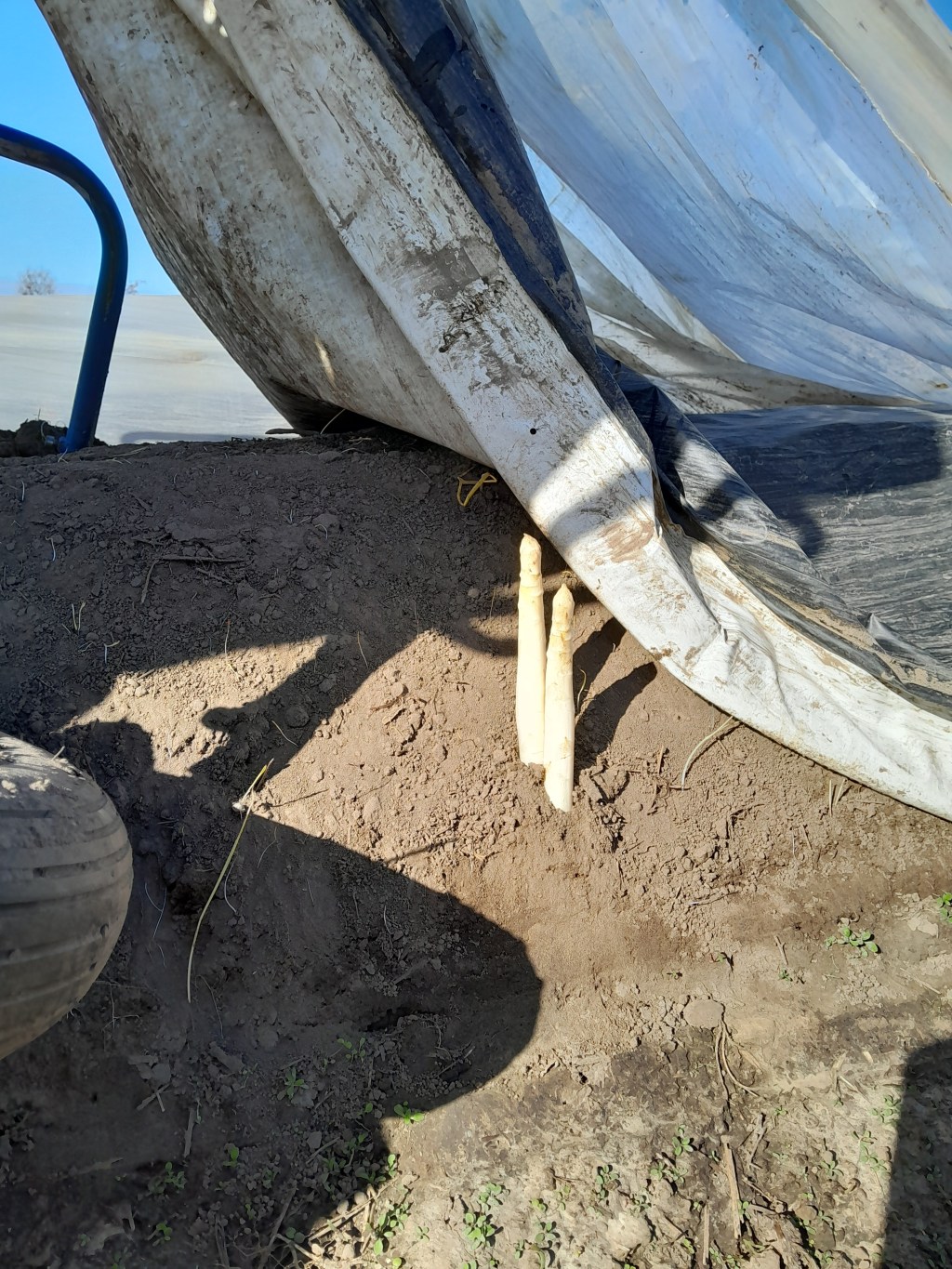
I had wanted to make it work. That was the essence of it. I had been told it was heavy work, long days; physical. It is true, I had felt a niggle of doubt about my back. The words of a certain surgeon might have floated momentarily: “You’ll feel it if you do a hard day’s work.” But my late father’s mantra that one must take whatever work there is — there’s no room for fuss pots here, is firmly rooted in my psyche. This, along with “firewood should keep you warm three times” were the kind of home truths that I grew up with. And what’s more, I hadn’t had any offers of employment recently, which meant that the urge to take whatever work might finally be on offer was strong. There were other reasons, too, why becoming an asparagus harvester seemed like a great idea: it was providing something useful – a vegetable – grown sustainably and without undue destruction of nature or climate. It was exactly the kind of thing that ticked all the ethical boxes.
Now, as I have said, I was very much looking for all the reasons why it was a good idea to travel to the asparagus fields of Western Europe in order to gain some employment there, however humble, and thus have money with which to pay the bills. This was, as we might say, a case of confirming what I wanted to believe. I watched a short video clip of a worker walking along a row behind a machine, occasionally stabbing at the white spears here and there. It was intriguing, this asparagus business. I had only ever encountered green asparagus in home gardens, and these white things that were kept in the dark were something completely different. The video showed how the machine niftily lifted two layers of plastic at one end, allowing the harvester to gather whatever asparagus was peeking above ground, before replacing the plastic again at the rear. As long as my back could handle the repeated bending, all would be well. Or so I thought. I packed the anaesthetic gel just in case — not that it would do much.
The night before I left for The Netherlands, I was up much later than I’d planned. I was, yet again, trying to prove that I was who I said I was, and that I had some kind of address to which I had some kind of connection. That I was about to leave this address in search of work was unfortunate timing, but it couldn’t be helped. My intention had been to go to bed early, given the early start required the following morning, but this was possibly the last chance to prove these things once and for all. I received a helpful message in response to my request for assistance: “For what it’s worth, the difficulty here wasn’t anything you did wrong – it came down to how Stripe’s identity verification works, and their system unfortunately doesn’t accommodate everyone’s circumstances equally.” It was nice to hear it wasn’t anything I did wrong, because it usually is. Stripe – the payment system which I had unsuccessfully been trying to convince that it really was me – was to blame. This was some relief. The message also confirmed my initial impression, which was that not everyone’s circumstances were equally well accommodated. Indeed, I have come to the realisation that registering charities and accepting donations is essentially something you do when you own your own house, or at least have a stable existence tied to a particular house, and can prove that you are real through more than just an ID card or passport. What it takes to prove I am me at this level I don’t really know. What I do know, is that the drawing of such distinctions means that while some can easily further themselves and their aims in the digital world and online, others cannot. I probably don’t need to point out the inequities and issues this raises. What to do about it is anyone’s guess. For now, I have accepted it is yet another case of acceptance.
With the benefit of hindsight, I can see that I probably should have done more research into asparagus harvesting. The video I watched may have been biased – it was a video aimed at potential asparagus harvesters looking to relocate from Eastern Europe. It did not show the intricate manoeuvring required at the end of each row, where the field abruptly ended in a ditch. To successfully turn the harvesting machine in such a tight place requires a certain amount of body weight, combined with a judicious use of force to swing it around at just the right moment. To say there was little room for learning is putting it mildly. Getting it wrong meant the machine, and possibly the operator, would end up in the ditch. The margin for error was slim to non-existent. To cut a long story short, I lasted about a day as an asparagus harvester. I was happy enough walking along the rows, but when it came to the end of the rows, I was out of my depth and beyond my limits. My short-lived career came to a mutually agreed end on the second day.
Why did I get myself into these kinds of situations, the social worker wanted to know? The question was both interesting in a long-term, philosophical kind of way, and completely irrelevant in a here-and-now kind of way. Why did I get myself into these situations? There it was again – that not-so-subtle hint that this was all my own choosing – a path I had freely chosen to embark on, much like a “choose your own adventure”. And in some way, that is how it was. I had chosen to come here. I had opted to try my hand at asparagus harvesting. No one had stood over me insisting this was something I should do. Yet, I had also reached a point where I felt like I was running out of options. My short stint as an asparagus harvester drove home the kind of cycle I had got myself into.
Nevertheless, individuals don’t exist in isolation. Individuals exist within a web of social conditions and circumstances that are beyond their own making. Some people will argue that suicide is 100% a personal choice. Getting on a small boat to cross a dangerous stretch of water in the hope of a better life is a personal choice, but it is a choice that has been heavily shaped by conditions and circumstances. We could say that any refugee is making a choice when they decide to move elsewhere, and that everything that happens to them from then on is of their own making, and that it is for them to resolve this all by themselves because that is what taking responsibility is all about. To me, this is taking the case for personal responsibility to a brutal, unhelpful extreme.
The feeling I got from my short time in the Netherlands was of a country groaning at the seams. Perhaps it was a case of so many people having been welcomed for so long, that things are now at a point where there just isn’t the room or resources or enthusiasm for welcoming any more. Yet, if that is the case, it begs the question why temporary workers, predominantly from the poorer parts of Europe, are being recruited to work in seasonal labouring positions. Was it that no one wanted to do these jobs? The work and living conditions were certainly not at a level that the average Western European would generally settle for. I wondered if it was like a modern form of colonialism. The jobs might get dressed up as being a splendid opportunity for the poor cousins of Eastern Europe to earn some money and advance themselves, but the opportunity left a lot to be desired and certainly wouldn’t be suitable for everyone. And if it fell through, as it had for me, then there were some who were more than ready to argue that it was a case of cold comfort – take some responsibility and sort yourself out: you are perfectly able to return to the poor country you came from.
I have had jobs fall over before. I have travelled greater distances in the hope of employment, only to find that there were issues that made it untenable to stay on. For some reason, this particular instance piqued me in a way that I hadn’t experienced before. I wasn’t sure why. Maybe it was the fact that here was an affluent, Western European country recruiting migrant labour, with seemingly little real regard for the ins and outs or potential consequences of it. Maybe it was my own Dutch heritage, which created an unfounded sense that I should belong and feel more welcome here than I did. Whatever it was, I stuck around for a week longer. My erstwhile employer was forthcoming with letting me stay on for a while, and offering to offset my costs. As luck would have it, it was the Easter Holidays. This meant there was no response to my enquiries about other employment or housing, and then it was time to go.
On my final night in the Netherlands, I slept in the open under a stand of trees. These trees were part of what was called a forest, although I would hesitate to call it that. The branches groaned and squeaked. A mouse came to check out what I was doing there. After the birds had shushed themselves for the night, there was that period when the light drains away until it is just the dark outline of branches overhead. I considered that this was where my ancestors had lived, not so very far from here, in their little village where they made themselves huts from slabs of peat, and kept goats and worked at labouring jobs. It felt strange to think about it like that, how the generations had continued and now I was lying here under these trees. I thought of the four desperate migrants who had died trying to cross the Channel that morning. Some days it felt like the world consisted of little more than varying degrees of desperation. I can count myself lucky.
-
Reflections on a Winter in Ukraine
Lessons in warmth and humanity
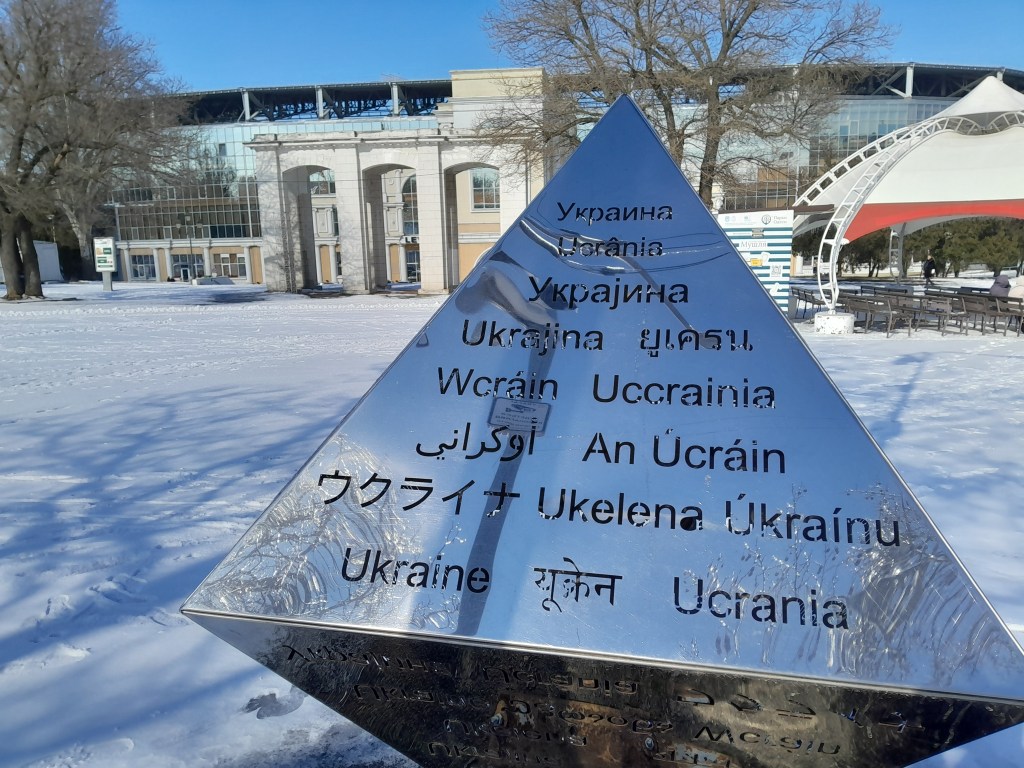
If there is one thing that sums up my time in Ukraine, I think it is this. It would be hard to go there and not leave with a sense that here are people who manage to keep showing up, even under the most trying conditions. And not just showing up, but holding on to the warmth and colour and spirit that makes us human. At the Goncharenko Centre, a hub for weaving camouflage nets, I also saw all manner of craft classes taking place – from the creation of Christmas decorations and bracelets, to colourful toys and ornaments. On the weekends there were language classes – I participated in the English sessions, but there were other languages on offer too. During the time I spent with the organisation “Food for Life”, I helped cook vegetarian meals – these were prepared from scratch every morning, ready for distribution to those in need by lunchtime. Many people came to volunteer in the kitchen – young and old, Ukrainian and foreign, men and women; religious and atheist.
When I thought about the volunteering itself, it occurred to me that it was not just about giving to others, but also about the connection and spirit it fostered, and the sense of happiness and warmth it gave. As a foreigner, I feel it is a privilege to have the time and opportunity to do it – not everyone is in a position to do so. Those three months felt meaningful, more meaningful than a lot of other things I’ve done. For some Ukrainians I talked to, it is a necessity – something that simply has to be done. Yet I felt that the people I met were also happy to be there – the sense of spirit and community was strong. Sometimes, when I got on a bus or walked down a street, I wondered how many people were involved in something like this. I really had no idea. There were times in public places when I was struck by a sense of people being worn out, and of life being bleak and grey.
The boy on the bus
One of the main methods of public transport in Ukrainian cities is the humble маршрутка (marshrutka) or share taxi. Marshrutkas are typically a small yellow bus, although they also come in other colours, that travel a fixed route and charge a fixed fare. To me, they are closer to a bus than a taxi in both appearance and function. The marshrutkas are typically well utilised, and it is not uncommon for there to be standing room only. It was on one of these marshrutka journeys that I found myself standing next to a boy who I judged to be about fourteen or fifteen. He had a camouflage-coloured hat suspended from its string around his neck. On his lap he held a bag with various sewn on patches – some kind of skull, a fighter jet, and other military themed things I couldn’t work out. He looked glumly out of the window. If he was about 14 or 15, he would have been 10 or 11 when the war started, which meant that he was coming of age in a country at war. I considered that if I saw the same boy on a bus in Western Europe, I would probably feel some concern about his apparent interests, and whether he was OK. And yet in this context, he seemed almost unremarkable. He had every reason to be glum. Maybe he would sign up for the military as soon as he was old enough – if the patches on his bag were anything to go by, it would seem likely. Although he might be exactly the kind of boy the country wanted, I felt a heaviness on his behalf.
The old lady on the corner; the old man at the intersection
I was shocked, on a cold dark night, to find an old lady selling items on the street not far from my lodgings. She sat half-asleep amongst a collection of old soft toys, hats, a bedroll and various household items. As soon as she noticed me her face lit up in a bright smile. Yes, she was OK. She had an apartment not far away, just around the corner a bit, she said. It was on the spacious side, the pension was small, and the heating bills were higher in a bigger place. She was doing what she could, she said. I saw the man at the intersection more than once. He too looked cheerful, and exceedingly grateful to receive what small change I had in my pocket. I was told elderly people can get a heating allowance, but still there were these cases of hardship. With all the funds going to various initiatives, I wondered if this was a demographic that was being overlooked. Yet the people themselves might well say that sitting on a cold street corner for a few hours was simply their contribution to the war effort.
Dinner in the dark
The frequent power cuts didn’t bother me so much, as did the reason for them. There is something uniquely depressing about sitting in a dark flat, eating cold food, because someone has deliberately struck and destroyed parts of the power supply — again. I could say I come from a background of making do. The power cuts and occasional lack of water were not unlike the days when I tried to run my life off two small solar panels in a grey Winter, and a 1000 litre water tank in a dry Summer. But the reasons for it were much different. My camping lifestyle was at least to some extent self-chosen. This was externally imposed. And I was aware that it would be much different if I had young children to take care of, for example. As it was, dinner by candlelight became something of a regular thing and I rather enjoyed it.
A couple of times the power cuts lasted for a few consecutive days. At one point I noticed the milk had gone off — the fridge was at room temperature by then. Having disposed of it, I unthinkingly picked up another bottle the next day, only to arrive home and remember –that’s right, no power! Then it occurred to me that I could put the milk on the windowsill outside, and that it would keep very cool out there. It was a bit precarious, and I considered that if there were a gust of wind or a heavy blast during the night, then the milk would end up in the neighbour’s courtyard below. They might get a fright. No, the neighbours round here were used to more than flying milk bottles. In fact, a flying milk bottle might actually be a welcome change. The windowsill fridge was a winner.
The man under the tree
The two occasions on which I have had dealings with the emergency services in Ukraine had nothing to do with war — at least not in any direct sense. They were both cases where alcohol was very likely, or almost certainly, involved. And now, as I walked towards the bus stop at the end of my time in Ukraine, I came across a man slumped beside a tree in the middle of a pedestrian area. My first thought was that he was probably drunk and sleeping it off. It was a rather unfortunate and uncomfortable-looking sleeping spot, but what to do? There was not really much that one could do, at least not in the space of a few minutes as a passer-by on the street. I also had the same thought I had had before – that calling the emergency services would possibly mean taking them away from something vastly more urgent, to something which they too could do little about. There was the possibility that he had some medical condition that was not alcohol related, yet I had the judgemental thought that it probably was alcohol, and that in this case it was his own fault.
Normally, whether something was or wasn’t someone’s own fault wouldn’t really factor into my thinking. But in this context, it did. When missiles were flying about, and part of the population were away fighting and risking their lives at the front line, and other people were keeping busy with other necessary stuff, what right did anyone have to be lying around on the street being drunk? And what hope could they have of assistance? Still, it felt there should be something that could be done about it. This was the third incident of its kind that I’d come across. People passed by – it was likely a familiar scenario, acknowledged in a characteristically local way by flicking one’s neck a couple of times. At least I’d learnt that much. This was silent shorthand for “drunk”. I had already reached the conclusion there wasn’t much more I could do, and so I too carried on. As I said before, these incidents had nothing to do with the war. Or maybe they did.
All men, please present your documents
The great manhunt. Now we were at the border, and every man on that bus had better have their reasons. This was a case of every man potentially being a Wanted Man. I felt a gnawing anxiety. Suppose there was a man on board that had just decided they needed a break? Or a man whose partner, and maybe his family, were elsewhere and he just wanted to go and visit, no questions asked? All the men on that bus would have to be too old, too young, too broken, in possession of too many children, or in possession of just the right document, or somehow else exempt from the need to potentially serve in the military. Unsurprisingly perhaps, it seemed that all the men on board fitted into one of these categories, and we could proceed to the next checkpoint.
I feel ‘The Wanted Man Policy’, as I’ll call it, is counter-productive. I considered some of the human rights implications of potentially being forced to go to war in a previous piece, and there are many. But this idea that men can’t leave the country unless they have been exempted or excused or given some kind of formal waiver, really doesn’t seem to have a lot going for it. For one thing, taking a break from a country at war seems a reasonable thing to do. And for another, I cannot see how shackling all fighting age men to the country at a time when the country itself is economically hobbled, makes much sense at all. If the men who have no intention of fighting could leave, then they could do what many women have done – pursue training and employment options elsewhere. This would mean they have skills that can be brought back to Ukraine, money that can be invested into Ukraine, and more hope for the future. A second reason against imposing this level of restriction is that any coercion of this kind risks destroying goodwill and breeding resentment. And so, after three months of warmth and hope despite ongoing drone attacks and regular power cuts, it was with an altogether different feeling that I crossed the border out of Ukraine.
-
Subscribe
Subscribed
Have a WordPress.com account? Log in now.

