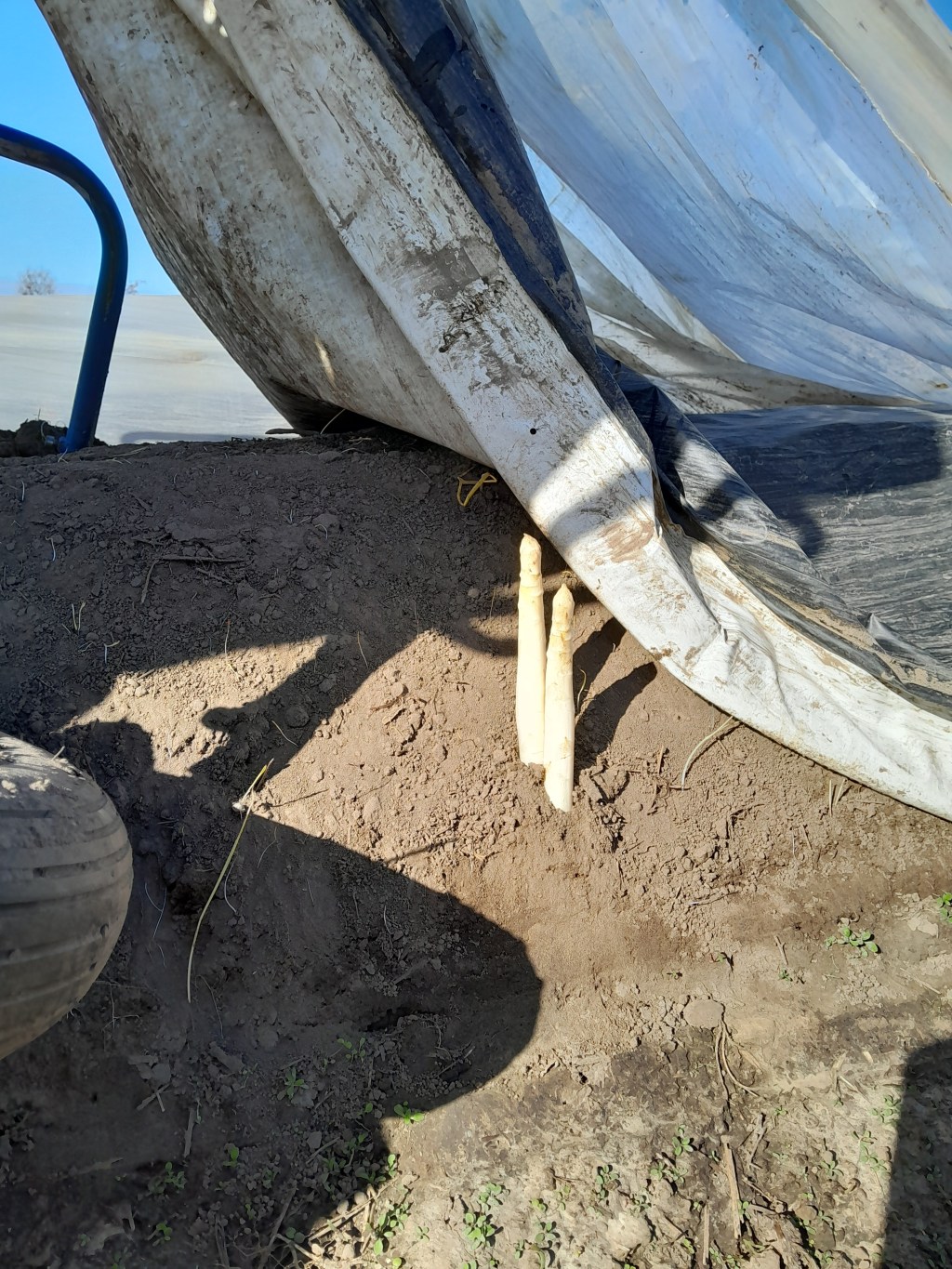
I had wanted to make it work. That was the essence of it. I had been told it was heavy work, long days; physical. It is true, I had felt a niggle of doubt about my back. The words of a certain surgeon might have floated momentarily: “You’ll feel it if you do a hard day’s work.” But my late father’s mantra that one must take whatever work there is — there’s no room for fuss pots here, is firmly rooted in my psyche. This, along with “firewood should keep you warm three times” were the kind of home truths that I grew up with. And what’s more, I hadn’t had any offers of employment recently, which meant that the urge to take whatever work might finally be on offer was strong. There were other reasons, too, why becoming an asparagus harvester seemed like a great idea: it was providing something useful – a vegetable – grown sustainably and without undue destruction of nature or climate. It was exactly the kind of thing that ticked all the ethical boxes.
Now, as I have said, I was very much looking for all the reasons why it was a good idea to travel to the asparagus fields of Western Europe in order to gain some employment there, however humble, and thus have money with which to pay the bills. This was, as we might say, a case of confirming what I wanted to believe. I watched a short video clip of a worker walking along a row behind a machine, occasionally stabbing at the white spears here and there. It was intriguing, this asparagus business. I had only ever encountered green asparagus in home gardens, and these white things that were kept in the dark were something completely different. The video showed how the machine niftily lifted two layers of plastic at one end, allowing the harvester to gather whatever asparagus was peeking above ground, before replacing the plastic again at the rear. As long as my back could handle the repeated bending, all would be well. Or so I thought. I packed the anaesthetic gel just in case — not that it would do much.
The night before I left for The Netherlands, I was up much later than I’d planned. I was, yet again, trying to prove that I was who I said I was, and that I had some kind of address to which I had some kind of connection. That I was about to leave this address in search of work was unfortunate timing, but it couldn’t be helped. My intention had been to go to bed early, given the early start required the following morning, but this was possibly the last chance to prove these things once and for all. I received a helpful message in response to my request for assistance: “For what it’s worth, the difficulty here wasn’t anything you did wrong – it came down to how Stripe’s identity verification works, and their system unfortunately doesn’t accommodate everyone’s circumstances equally.” It was nice to hear it wasn’t anything I did wrong, because it usually is. Stripe – the payment system which I had unsuccessfully been trying to convince that it really was me – was to blame. This was some relief. The message also confirmed my initial impression, which was that not everyone’s circumstances were equally well accommodated. Indeed, I have come to the realisation that registering charities and accepting donations is essentially something you do when you own your own house, or at least have a stable existence tied to a particular house, and can prove that you are real through more than just an ID card or passport. What it takes to prove I am me at this level I don’t really know. What I do know, is that the drawing of such distinctions means that while some can easily further themselves and their aims in the digital world and online, others cannot. I probably don’t need to point out the inequities and issues this raises. What to do about it is anyone’s guess. For now, I have accepted it is yet another case of acceptance.
With the benefit of hindsight, I can see that I probably should have done more research into asparagus harvesting. The video I watched may have been biased – it was a video aimed at potential asparagus harvesters looking to relocate from Eastern Europe. It did not show the intricate manoeuvring required at the end of each row, where the field abruptly ended in a ditch. To successfully turn the harvesting machine in such a tight place requires a certain amount of body weight, combined with a judicious use of force to swing it around at just the right moment. To say there was little room for learning is putting it mildly. Getting it wrong meant the machine, and possibly the operator, would end up in the ditch. The margin for error was slim to non-existent. To cut a long story short, I lasted about a day as an asparagus harvester. I was happy enough walking along the rows, but when it came to the end of the rows, I was out of my depth and beyond my limits. My short-lived career came to a mutually agreed end on the second day.
Why did I get myself into these kinds of situations, the social worker wanted to know? The question was both interesting in a long-term, philosophical kind of way, and completely irrelevant in a here-and-now kind of way. Why did I get myself into these situations? There it was again – that not-so-subtle hint that this was all my own choosing – a path I had freely chosen to embark on, much like a “choose your own adventure”. And in some way, that is how it was. I had chosen to come here. I had opted to try my hand at asparagus harvesting. No one had stood over me insisting this was something I should do. Yet, I had also reached a point where I felt like I was running out of options. My short stint as an asparagus harvester drove home the kind of cycle I had got myself into.
Nevertheless, individuals don’t exist in isolation. Individuals exist within a web of social conditions and circumstances that are beyond their own making. Some people will argue that suicide is 100% a personal choice. Getting on a small boat to cross a dangerous stretch of water in the hope of a better life is a personal choice, but it is a choice that has been heavily shaped by conditions and circumstances. We could say that any refugee is making a choice when they decide to move elsewhere, and that everything that happens to them from then on is of their own making, and that it is for them to resolve this all by themselves because that is what taking responsibility is all about. To me, this is taking the case for personal responsibility to a brutal, unhelpful extreme.
The feeling I got from my short time in the Netherlands was of a country groaning at the seams. Perhaps it was a case of so many people having been welcomed for so long, that things are now at a point where there just isn’t the room or resources or enthusiasm for welcoming any more. Yet, if that is the case, it begs the question why temporary workers, predominantly from the poorer parts of Europe, are being recruited to work in seasonal labouring positions. Was it that no one wanted to do these jobs? The work and living conditions were certainly not at a level that the average Western European would generally settle for. I wondered if it was like a modern form of colonialism. The jobs might get dressed up as being a splendid opportunity for the poor cousins of Eastern Europe to earn some money and advance themselves, but the opportunity left a lot to be desired and certainly wouldn’t be suitable for everyone. And if it fell through, as it had for me, then there were some who were more than ready to argue that it was a case of cold comfort – take some responsibility and sort yourself out: you are perfectly able to return to the poor country you came from.
I have had jobs fall over before. I have travelled greater distances in the hope of employment, only to find that there were issues that made it untenable to stay on. For some reason, this particular instance piqued me in a way that I hadn’t experienced before. I wasn’t sure why. Maybe it was the fact that here was an affluent, Western European country recruiting migrant labour, with seemingly little real regard for the ins and outs or potential consequences of it. Maybe it was my own Dutch heritage, which created an unfounded sense that I should belong and feel more welcome here than I did. Whatever it was, I stuck around for a week longer. My erstwhile employer was forthcoming with letting me stay on for a while, and offering to offset my costs. As luck would have it, it was the Easter Holidays. This meant there was no response to my enquiries about other employment or housing, and then it was time to go.
On my final night in the Netherlands, I slept in the open under a stand of trees. These trees were part of what was called a forest, although I would hesitate to call it that. The branches groaned and squeaked. A mouse came to check out what I was doing there. After the birds had shushed themselves for the night, there was that period when the light drains away until it is just the dark outline of branches overhead. I considered that this was where my ancestors had lived, not so very far from here, in their little village where they made themselves huts from slabs of peat, and kept goats and worked at labouring jobs. It felt strange to think about it like that, how the generations had continued and now I was lying here under these trees. I thought of the four desperate migrants who had died trying to cross the Channel that morning. Some days it felt like the world consisted of little more than varying degrees of desperation. I can count myself lucky.

