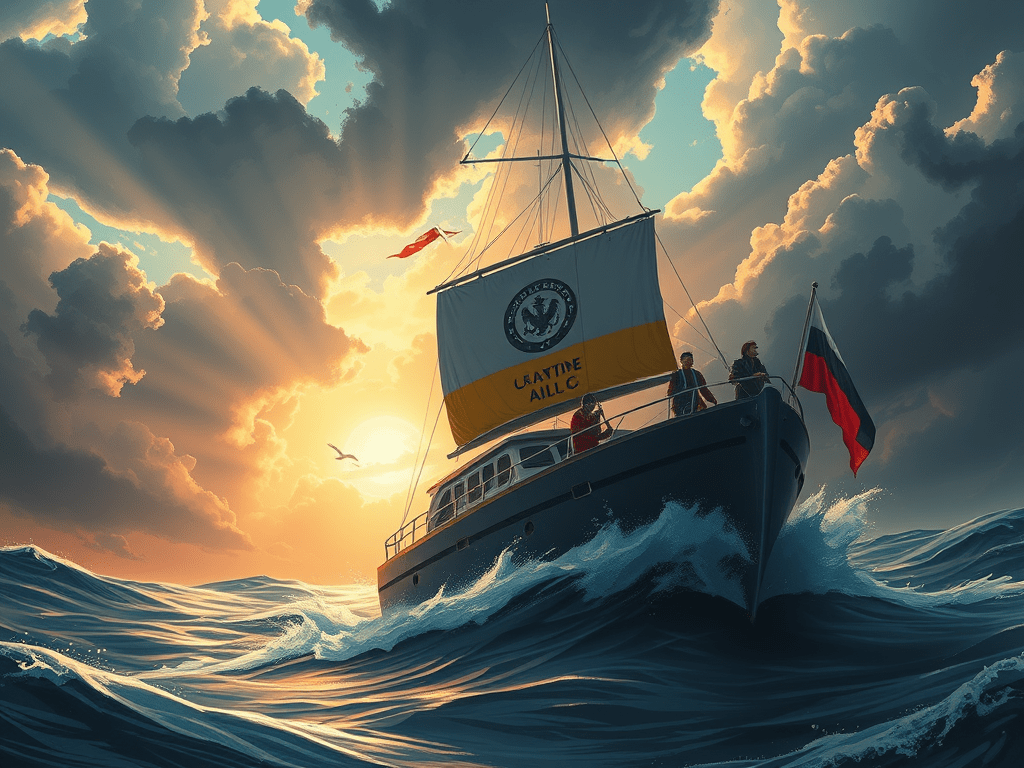
The news that an activist yacht bound for Gaza was intercepted invoked mixed feelings. Apart from the team of 12 activists including Greta Thunberg, the yacht was carrying a ‘symbolic amount’ of humanitarian aid. First, good on Greta for doing something. Here she is yet again, a Swedish teenager taking it on herself to try and do something about the injustices of this world. It’s a great deal more than what most of us manage to do. For me, the uncomfortable question brought to mind by the images from that yacht was – is it actually helping?
I mean, I can relate to Greta in the sense that I see a little bit of myself in her, when I was younger and angrier. I was either against things, or I was for saving them. There was a time when, as a student, I studied on weekdays and marched righteously up a hill on the weekend to protest against a windfarm, or against the damming of a wild river. I had innumerable stickers exhorting everyone to save things: rivers, dolphins, forests; or to stop them: mining, pollution, tree-felling. I wrote impassioned letters. Later, having been detained in a state institution and experienced a bit of what that can involve, my activism switched to a more humanitarian vein: I became more interested in what happens to people at the hard end of the societal systems which are supposed to be fair, protective and reasonable.
Looking back, it was a very ad hoc, piecemeal approach to activism. While I was more or less informed, in an environmental sense, on the issues I campaigned on, I moved from one righteous good cause to the next. If someone asked why I was protesting a windfarm or dam when these were renewable alternatives to more destructive means of electricity generation, my response was simply that this particular place was not the right one, and they should find somewhere else. Unlike Greta, I did not have a team with whom to moderate ideas or formulate plans – I largely acted alone, or in concert with a handful of others who shared the love of a particular hill, river or species. I was limited to a very localised area, so the chances of getting mixed up in international politics and agendas were minimal to zero. This was probably just as well.
What strikes me about Greta’s mission on the Madleen is this – how much thought did these fellow activists put into what they were doing? Contingency plans, yes. But in terms of the bigger picture? It would seem that in terms of the humanitarian aid itself, it is fair to say this was a negligible amount. In a situation as dire as that facing Gaza, is bringing a ‘symbolic’ or tokenistic amount of aid really what the people of Gaza need or want? I mean, imagine the possible response to this yacht arriving with a token amount of supplies on board, and then trying to distribute this small offering in a civil manner to thousands of starving people. Is that fair? Is it a sensible thing to try and do? And is it an ethical means of raising awareness? Thunberg mentioned solidarity and standing with the Palestinian people in an interview upon her return to Europe, the idea being that people can know they are not forgotten. Once again, a good intention, but at what potential cost? If the situation were less dire and immediate, then sailing a yacht into the harbour might well be a welcome move. But in the current situation, there is a chance it could just be irritating and even outright dangerous in potentially creating further chaos.
As far as awareness-raising goes, these kinds of strategies have a long-standing history. It comes out of the same playbook as activists chaining themselves to buildings or trees, blocking motorways to raise awareness of climate change, or otherwise doing something that causes just enough disruption or discomfort so as to draw direct attention to a problem. By this measure, we could say that the yacht voyage was at least a partial success. The Israeli response was perhaps not unexpected, nor the fact that they might in turn try and use the situation to their own advantage by showing footage of the activists being given water and sandwiches. Awareness raising has long been the rallying cry of many activist missions. But at what point does that need to switch to something else? Awareness is critical in the sense that people have to be aware that something is a problem before anything can be done about it. But once that much has been achieved, there arguably needs to be some kind of Action 2.0 upon which to draw. The risk with too much awareness raising is that it actually does the opposite of what it intends to: that we tune out knowing there is little chance of having any measurable impact on the outcome.
Greta suggests the world needs more angry young women. Certainly, the media has picked up on one angry young woman and made sure that her activism is highlighted. The average angry young-woman-activist is probably still more likely to be shut down, excluded, maligned or ignored. Whether it’s helpful to encourage more people down that path as individuals is debatable, unless it is as part of a more coherent, cohesive movement with backing behind them. The yacht voyage is the type of activism that is high-profile, headline generating, and somewhat sensational. What it achieves in real terms is hard to know. There is the potential for people to be turned away by what could be deemed a publicity stunt-move. A thoughtful, coordinated approach to activism might see these kinds of tactics replaced by something more unifying and less attention-grabbing.
Image & Title Credit: AI
 Fuzzy Brown Line