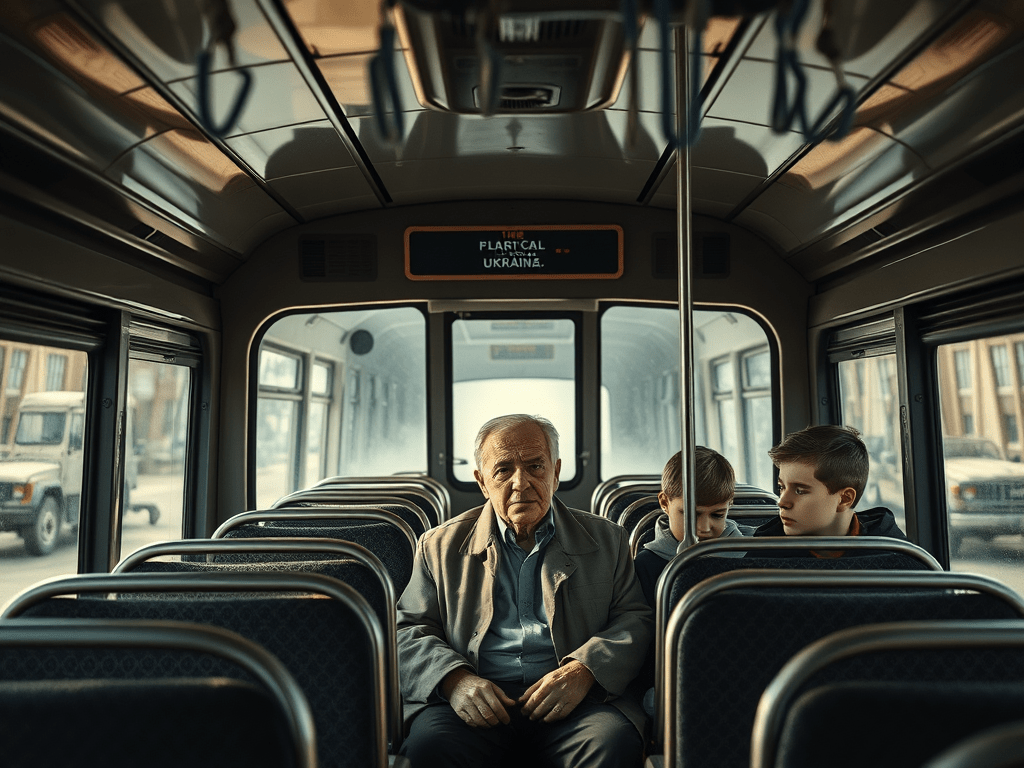
As it stands, I would not want to be a fighting age male in Ukraine right now. I probably wouldn’t want to be a fighting age male in other parts of the world either, for that matter. This thought has occurred to me before today. The first time it really hit home was when I boarded a bus to Ukraine towards the end of ’22. I was aware of martial law and what it entailed. Even so, it took me a while to register why there were hardly any guys on the bus — just a few young boys and an elderly man. It hit me then that the expectations placed on men and women in a country at war were vastly different. The levels of restriction each experienced under martial law were also very different. If it seems an obvious realisation, it is – but it took that moment to really feel it.
I do not know for sure how I would think if I were male instead of female, but I suspect my views on conflict and the military would be much the same. These views are not something which are tied to my sex or gender, as much as they are to concepts of right and wrong, past experience, and understandings of the way the world works. So, if I were a man, I could be facing the possibility of conscription or mobilisation, which would be at odds with my conscience – at least as far as the military in its current form goes. This would leave me with limited choices. I was going to say it would leave me with ‘difficult decisions’, but if push came to shove, there might be no deciding about it at all.
I was curious to know how males in Ukraine felt about this possibility, and I got a chance to find out when I met a group of three young guys who were internally displaced persons from another part of the country. “Yes,” one of the guys joked darkly, “we’re all meant to want to go to the enlistment office and sign up for our sub-machine gun”. The three of them had no intention of doing so – “we help in other ways”, and that seemed fair enough to me. But there was a potential expectation on them, and they were only too well aware of it – it was best not to draw attention to oneself in any way, as that could result in being called up. That was more than three years ago now.
The mobilisation of males seems like something as old-fashioned as the idea of the military itself. In today’s world, where men and women are generally perceived as equally capable of performing roles that were once strictly for one or the other, it feels a very outdated concept. Women have proved themselves capable as soldiers – so that can’t be a concern. And men can be just as averse to engaging in warfare as women, for equally valid reasons. So, this begs the question – why have mobilisation for some and not others?
I have seen one line of reasoning that suggests women, by way of giving birth to children, must be spared for that reason. To my mind, this too is an old-fashioned sentiment. While it’s true that males are not as critical to have around in terms of the physical bearing of offspring, the idea that they are somehow less necessary to the rearing of children more generally deserves careful thought. In an age where many people are choosing not to have children at all, the idea of exempting women for that reason is also questionable.
Maybe the question at its root is this: should anyone be forced to go to war? And regardless of gender, are some better suited to going to war than others? A military recruitment page I looked at specifies that recruits must be willing to go to areas of active combat operations, as well as being psychologically sound and of good moral character. We might question whether anyone willing to go into active combat can really be psychologically and morally sound in the fullest sense of those words. To be prepared to die, to take life, and to willingly engage in physical fighting, would not usually be associated with full psychological and moral soundness. Outside of the context of war, it would generally sit closer to definitions of insanity and mental disorder.
Naturally, this takes me to the next point – that of necessity. It’s all very well to sit at a safe distance in the relative quiet and comfort of civilian life, offering criticisms and commentary. I can’t claim I come from a long line of pacifists: at some point my own ancestors decided that Hitler’s Germany was enough of a threat to warrant taking up arms. But is that still the answer? These are not the days of Nazi Germany, and the world has moved on in so many ways. Nevertheless, threats from dictators and the use of force remain present today, just as they were back then. When I think about what I would personally be willing to do, or how far I would go, my conclusions generally come back to the same point: the military, yes – but without the violence. I sense this is a bit like saying “the church, yes — but without the religion” in that it represents a fundamental contradiction of what these institutions are all about.
Incredulous responses are perhaps to be expected. How can an institution that has always been about ‘fighting with enemies’ possibly be about anything else? Well, I would argue that there are potential ways to make enemies see the error of their ways that don’t involve physical fighting and bloodshed. Yet the old views and ways are so deeply embedded and entrenched, as to be almost beyond question. First, we have the idea that males are naturally obvious candidates for fighting. Then there is the idea that physical fighting is what the military does, and that it’s a worthy, noble and honourable thing to do. Finally, there is a narrow definition of fighting that necessarily involves guns, tanks, drones – or whatever the latest lethal invention might be. The idea of fighting without recourse to violent means is out there. It just hasn’t gained much traction yet.
Image credit: A.I.
 Fuzzy Brown Line